Monday, September 29, 2014

MoistureLevel smart foundation system for Expansive soils


In my last few blogs I pointed out how a majority of homes and commercial properties in arid climates get misdiagnosed, and that the majority of soil related damage ends up being heave. Up until now there have been no really viable solutions for that problem….. Until now.

Many years ago I started thinking about how I can solve the seemingly intractable problem of floor slab heave. Over the years I have worked on many ideas with not much success until I returned to the idea of soil venting. Now I am pleased to say that after much long work I have developed a solution that is cost efficient, effective and is non-intrusive. My patent is now pending.

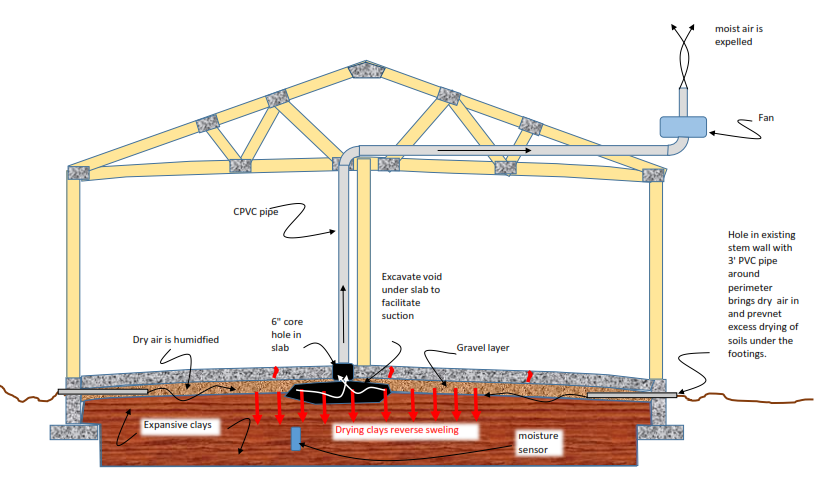
The idea is to use the dry air as it is forced across the soils collecting the moisture and venting it out the stack. As the soil becomes drier, it begins to suck the moisture out of the adjacent clays. As the clays begin to dry out they develop cracks which then dries out the soil near the crack causing it to expand causing it to deepen and make more cracks continuing a self-reinforcing cycle.  Over time the clays begin to lose their moisture and cease to expand and in many cases reverse.


The system has protections to minimize any over drying near the footing area. It also has a smart mechanism that monitors the soil moisture content and regulates the drying to protect from over drying.

The system is easy to install usually taking less than a day. The costs are usually less than 1/10th the cost of other less effective measures of heave control and has the following benefits:


  • It controls moisture of the clays under the slab in an ongoing basis providing better long term confidence in other repair type solutions
  • It controls the indoor air quality for Radon (a radioactive gas) and other gases and pollutants that could be harmful that enter from the ground
  • It controls the issues of wet slabs that include delaminating tile, mold and slab curling.
  • There is some evidence although unconfirmed at this point that it provides some control for termites since it removes moisture under the slab.
In my next blog I will discuss how I came to think of this and how it compares to current methods of heave remediation of expansive soils. 
·         
·         
·         


Friday, September 19, 2014

How to remediate a heave


So now we have established that many homes have floor heave. And we have established that many homes get misdiagnosed. We have also established in my previous blogs that this is a significant occurrence.

So now if we have a structure with floor heave what are the real options for remediating it. They are as I see as follows:
  

  •  Cutoff walls 
  •   removal and replacement of interior slab
  • grading and drainage improvements
  • excavation lowering
  • correction smart foundation system
Let’s talk about these for a minute. I have put  in many cutoff walls. They are expensive and intrusive. They involve excavating a 5 foot wide by 1 foot deep trench all around the house, followed by a deep trench 4 feet deep. Plastic is then run from the bottom of the trench and attached to the edge of the stem wall of the house. Here is a picture:


·       
·         This process  is expensive and time-consuming. Somewhere in the neighborhood of $45-$75,000. 

    Removal and replacement of the interior slab is even more expensive and more intrusive. This basically is gutting the entire interior of the house including the floors and rebuilding it. The cost is somewhere in the neighborhood of $100,000-$200,000 and an involved moving out entirely and rebuilding and moving back. Not fun.

   We almost always recommend grading and drainage improvements on any house that has soil issues. Depending on the scope this may be relatively cheap or somewhat expensive. Many times this fails to fix the problem all on its own. Although it can help.

     We have also done many excavation lowering projects over the past 10 years. I pioneered this concept and believe it is still valuable. But it is also expensive and intrusive. Somewhere in the neighborhood of $40,000-$150,000. It also really only works on post-tension slabs as conventional slabs don’t really lend themselves to this kind of operation.

     So that leaves us with the last option on the list. What is the direction MoistureLevel? This is a revolutionary concept that I have pioneered with local geotechnical engineer David Deatherage and the a ASU geotechnical department.

     15 years ago I had a discussion with Dave about a building that he helped remediate the pollution underneath it. He did this with active soil depressurization, which is another word for drying the soils underneath. The chemical removal was successful, but it had a side effect of drying out the soils and because they were clays soils, caused the building to settle. We then put our heads together and thought why can’t we use this same concept to control the soils. Thus the MoistureLevel concept was born.

      Below is a refined concept of how that technology works.


·         

·        

     This is a patent pending technology that we are making available to anyone with floor slab heave. In my next blog I will discuss the details of the system and its benefits.