
So the house is 2” lower in one area vs another. Does that
mean it needs underpinning? Not necessarily. I have seen houses up to 9” out of
level with very little damage and houses out of level 1”to 2” out of level with
much more damage. What gives?
The house with 9” in this case had a very rigid slab and all
of the elevation difference was basically just a very steady, even tilt from
one side to the other. The house with a ton of damage and only 1-2 inches had a
huge bulge in the profile of the footing and floor. That “bulge is called
deflection. If the bulge side is like a bow and the tilt is the string, the
deflection is the difference between the bow and the string. In other words the
bend in the footing/slab is what creates stress on the structure.
Take
a look at the 2 profiles below. The first is tilt the second shows deflection.
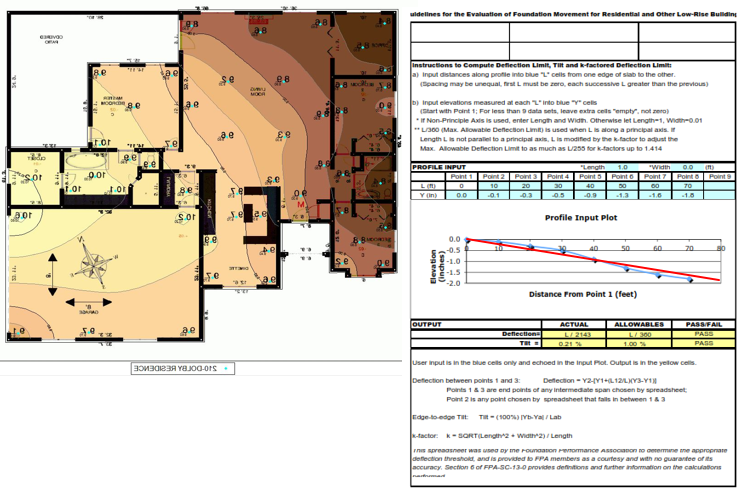
Notice how the profile shows a nice even slope from one side
to the other. Also see how the actual line does not deviate
from the red slope line. As you might suspect not much damage in this
house.

Now take a look at this one. See how there is a big
difference between the red line and actual profile? This house had lots of distress and was in bad need of leveling.
Now how can you determine deflection without having all of
the points and subsequent contour lines to plot? Obviously you cannot.
How much tilt or deflection is too much? Structures can
withstand a lot of tilt as compared with deflection as discussed above. The
Foundation Performance Association has developed a consensus of tilt of 1% and
deflection of L/360. Accordingly I feel those guidelines should be followed
unless a new and better consensus is ever developed.
So Now what happens if we discover with our careful analysis
that there is a floor slab heave and no footing movement? In my next blog I
will lay out the options including a revolutionary process developed by our
team.


No comments:
Post a Comment
Let us know your thoughts... leave a comment