Tuesday, February 23, 2016

Team Build Golf Mixer


Join the discussion here!


This was a super successful event with everyone having great time. Closest to the pin was contested in the virtual Room from the Pebble Beach Course by Bernie our instructor. Also driving instruction was given by Scott our 2nd Golf Pro.

Lunch, golf pro instruction 9 holes, and drinks provided by the sponsors. After the lunch and instruction we followed up with nine holes to practice the tips that we picked up. The weather was awesome and the networking was as usual very rewarding

This month’s Team Build was sponsored by:
           
          Arizona Foundation Solutions
          Euclid
          Jones Concrete
          Cornerstone Masonry
          Sideplate


Left to right:
 Fred Sobottka (Beauchamp, Rimkus, Structural Force)
 Chad Sipple, (MBJ)
 Clinton Wilkens(Salt River Materials).
 Bob Zuehl, (MBJ)
 John Ellis (JF Ellis),
 Tim Pierce, (Charles Court)
 Bob Brown, (AFS)
 Robert Hernandez (Jones Concrete),
 Dave Flax (Euclid)
 Bob Whalen (Trusdel),
 Jim Longworth(Cornerstone Masonry),
 Blake McGraw(Trusdel),
 Steve Leon (Carwraps AZ),
 Scott Palmer, (Salt River Materials)
 Missing Erin Conaway (Sideplate).
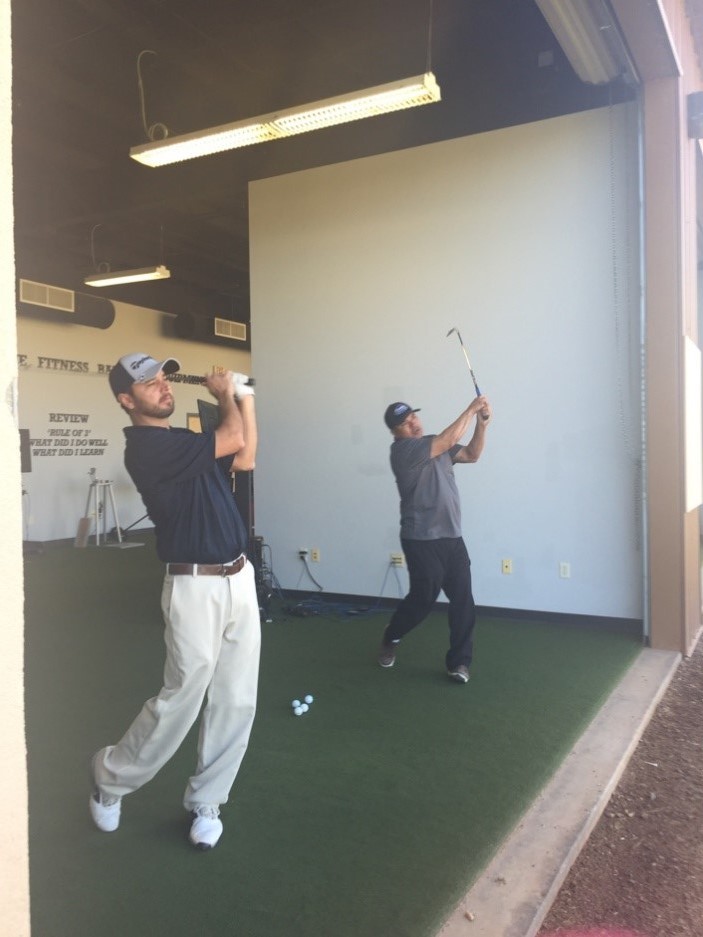

      Robert Hernandez and Tim Pierce practice driving in the performance Center.


Tuesday, February 9, 2016

Using sub slab depressurization to mitigate vapor transmissions

Join the discussion here!


In my last blog I discussed the vexing problem of vapor transmissions through slabs on grade. In my previous post, MoistureLevel system proves cost effective for treating vapor transmission, I discussed the damage and consequences of moisture vapor as well as moisture transmission through capillary suction in concrete slabs on grade.

I also discussed in more detail the difficulties with current approaches to resolving this problem that are costly, invasive, and present difficulties with performance.

Over the last 13 years David Deatherage PE and I have been developing sub slab depressurization systems. I have filed a patent with the patent trade office approximately 3 years ago and have been installing the systems for almost 2 years with almost 200 of them installed to date.


The advantages to using this system to control vapor transmission through slabs on grade are:
  • It is not invasive to install.  Most systems can be installed in one day or less.  No move out required and no moving of furniture or floor coverings.
  • It minimizes slab curling since it is drying the slab equally both top and bottom.
  • It is effective since it intercepts both vapor and liquid water before it encounters the bottom of the slab.
  • It is cost-effective.  Usually in the $1 per square foot range to install with an approximate $4000 and change minimum.
  • Longevity.  Since the fan runs continuously, the system controls future moisture problems.  The electricity to run the fan is comparable to a light bulb.
We are now installing this on several projects now for this type of remediation.  Stay tuned for case studies.

Wednesday, February 3, 2016

MoistureLevel system proves cost effective for treating vapor transmission

Join the discussion here!

Our vapor transmission slabs on grade vexing problem the industry has struggled with many decades. Millions of dollars of damage has occurred as adhesives fail, coatings de-bond from hydrostatic pressure, and sometimes so much water has been coming through that standing water can be observed in the surface of the concrete. This moisture transmission through slabs also promotes ASR or alkali silica reaction, a common problem here in the Southwest and other areas of the country where the aggregates have high silica content that reacts with the alkali of the cement. This produces a guey substance that forces its way to the top of the slab and in many cases breaks up the slab from internal forces. Phoenix Sky Harbor Airport is a victim of such a phenomenon.

Concrete is poured within excess of water typically called water of convenience that does not bind with the cement particles. This excess water takes many years to remove itself. In addition there are number of mechanisms that bring water under the slab. One such mechanism is clays suction from around the perimeter of a foundation. I document that more fully in my previous blog, "Evidence of MoistureLevel Smart Foundation System Performance.In addition through the “stack effect”, water vapor along with other gases is pulled in from around the perimeter of a structure to replace gases that are transmitted up through the foundation into the structure and by heat convection drawn up into the attic. This is a well-documented process for one of those gases, radon.

Particularly here in the arid Southwest, air-conditioning dries the surface of the slab promoting vapor transmission as well as condensation of water vapor as it is pulled through the slab. As water condenses the pH level is usually around seven which can promote dissolution and attacking of cement particles causing great greater voids in the concrete thus exacerbating the problem. Once this process has begun de-bonding of most surface treatments becomes more problematic over time.


Most solutions to this problem involve installing sealers on the surface of the concrete. This is problematic at best for the following reasons:

  • Hydrostatic pressure can be a very powerful force and is likely over time to build up and become strong enough to the bond almost any coating or floor treatment.
  • In order for sealing to be effective all floor coverings and all fixtures must be removed including kitchen, baths, built-in desks, and all cabinets. If this is not done than the vapor transmission becomes concentrated where it is not applied creating mold problems.
  • The inconvenience of removing everything necessitates full move out and accommodations to live and or work somewhere else until the project is done.
  • The cost of such a project is very expensive.

The problem here in the Southwest is exacerbated by the reluctance of installers to install a vapor barrier under the slab. Because of the arid hot curing conditions, placing a vapor barrier underneath a slab promotes extreme slab curling due to the difference of evaporation on the sealed bottom versus the open top.


In my next blog I will lay out the reasoning as to why he moisture level system is a suitable cost-effective solution to this problem.